
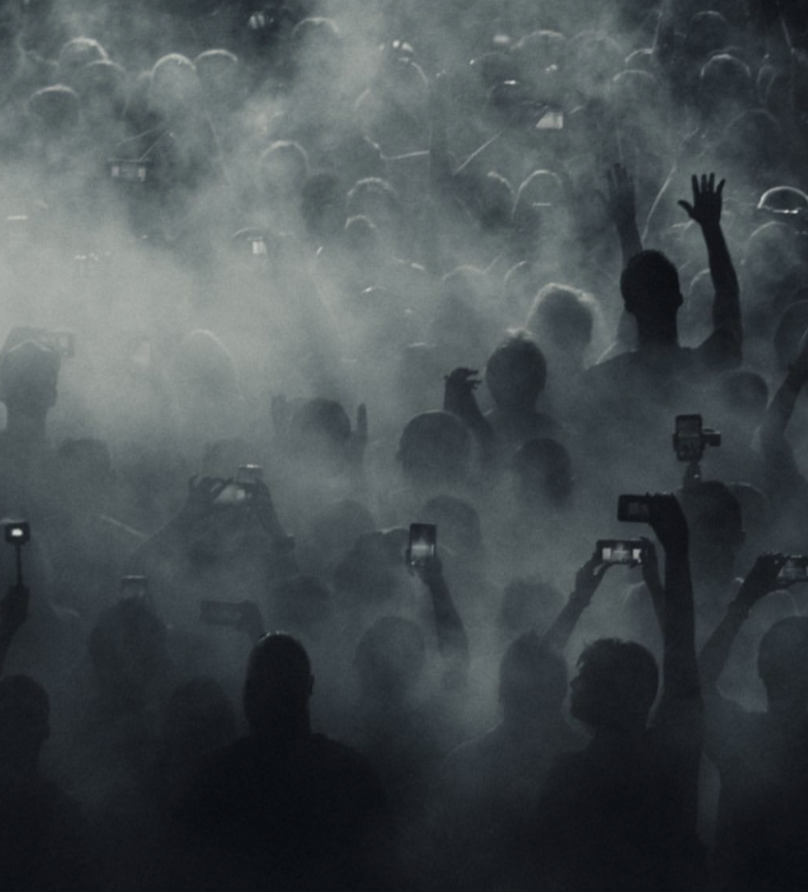
Why We Disappear Into the Dancefloor…
There is something psychologically unusual about the underground dancefloor.
Outside the club, darkness is associated with danger, uncertainty, or fear. Yet inside underground spaces warehouses, basements, smoke-filled rooms beneath monochromatic lights darkness often produces the opposite effect: safety, emotional release, and freedom. For many people, the dancefloor becomes one of the few places where they temporarily stop performing identity. Modern society is built around constant visibility. Social media, professional environments, digital communication, and public self-curation create what sociologist Erving Goffman described as the “presentation of self” the continuous management of how individuals appear to others. In The Presentation of Self in Everyday Life (1956), Goffman argued that human interaction resembles theatricalw performance, where individuals constantly regulate behavior to maintain social acceptance. The underground disrupt this process. Inside dark clubs, identity markers begin to dissolve. Status weakens. Appearance becomes secondary. Conversations become unnecessary. The ego slowly loses priority to rhythm, atmosphere, and collective movement. This phenomenon closely alignswith theories proposed by Carl Jung, particularly his concept of the “shadow” the hidden emotional dimensions of the self suppressed during ordinary social functioning. Jung argued in Aion (1951) that confronting darkness is psychologically necessary for wholeness: “One does not become enlightened by imagining figures of light, but by making the darkness conscious.”
The underground dancefloor creates precisely this environment: a temporary psychological suspension of ordinary identity structures. Research in music psychology supports this transformation. Studies conducted by researchers at McGill University and published in Nature Neuroscience demonstrated that emotionally powerful music stimulates dopamine release in the brain, particularly during moments of anticipation and emotional climax. Salimpoor et al. (2011) found that musical tension and release activate the same reward pathways associated with motivation, attachment, and emotional reinforcement. This explains why melodic techno feels emotionally overwhelming at specific moments in a set. The drop itself is not always the emotional peak. Often, the most intense psychological moment is the anticipation before release the suspended tension shared collectively by hundreds or thousands of people simultaneously. Repetition also plays a central role. To an outside observer, underground electronic music may appear mechanically repetitive. Psychologically, however, repetition functions differently. Research on rhythmic entrainment in neuroscience suggests that repetitive auditory patterns synchronize attention, movement, and emotional regulation across groups. Studies from University of Oxford examining synchronized movement found that collective rhythm increases social bonding, trust, and feelings of interpersonal connection. This helps explain why strangers on dancefloors often experience emotional intimacy without verbal communication. The dancefloor becomes a form of collective psychological alignment.
French sociologist Émile Durkheim described this phenomenon as “collective effervescence” in The Elementary Forms of Religious Life (1912). Durkheim argued that communal rituals generate heightened emotional states in which individuals temporarily lose themselves within collective energy larger than their personal identity. Although developed in relation to religious ceremonies, the theory applies remarkably well to underground electronic music culture. The modern dancefloor functions as ritual space. Music, synchronized movement, lighting, darkness, and repetition create conditions resembling trance states documented throughout anthropological history. Research from the fields of cognitive anthropology and ethnomusicology has repeatedly shown that rhythmic repetition and collective dancing can alter states of consciousness, reduce self-referential thinking, and intensify emotional absorption. A 2014 study published in Psychology of Music further demonstrated that immersion in music significantly reduces self- wareness and increases emotional openness, particularly in environments with reduced visual scrutiny. Darkness matters psychologically because it lowers perceived observation. Humans behave differently when they believe they are being watched. Psychological studies on self-awareness theory by Shelley Duval and Robert Wicklund showed that heightened visibility increases self-monitoring and social inhibition. In contrast, environments with reduced visual exposure decrease self-consciousness and encourage uninhibited behavior. This is why people dance more freely in dark clubs than brightly lit spaces. The underground scene intuitively understands this psychology. Smoke, shadows, strobes, low lighting, and monochromatic visuals are not merely aesthetic choices they are environmental mechanisms that reduce social performance and increase emotional immersion.
The emotional power of melancholic melodic techno also deserves attention. Contrary to assumptions that emotionally dark music increases sadness, research from Free University of Berlin found that melancholic music often produces pleasurable emotional processing rather than distress. Researchers suggested that sad music allows listeners to experience emotional depth without real-world consequences, creating a psychologically safe form of catharsis. This may explain why emotionally heavy melodic techno often feels healing rather than depressing. The dancefloor permits emotional confrontation without requiring explanation. No biography is needed there. No justification. No social performance review. Only sensation, movement, atmosphere, and collective emotional release. Anthropologists have long argued that communal rhythm and synchronized movement are among humanity’s oldest social technologies. Long before modern civilization, humans gathered around percussion, firelight, and ritual dance to create cohesion, emotional regulation, and shared identity. Electronic music may use machines, but psychologically, the mechanism underneath remains ancient. This is perhaps why underground culture continues surviving despite commercialization, digital overstimulation, and algorithmic entertainment. Beneath the sound systems and aesthetics lies something fundamentally human: the desire to temporarily dissolve separation. For a few hours inside darkness, individuals stop managing identity and begin experiencing presence. And perhaps that is why darkness feels safe on the dance floor: because in a world obsessed with visibility, the underground becomes one of the last places where people are finally allowed to disappear.
References
- Durkheim, É. (1912). The Elementary Forms of Religious Life. Paris: Alcan.
- Duval, S., & Wicklund, R. A. (1972). A Theory of Objective Self- awareness. New York: Academic Press.
- Goffman, E. (1956). The Presentation of Self in Everyday Life. Edinburgh: University of Edinburgh Social Sciences Research Centre.
- Jung, C. G. (1951). Aion: Researches into the Phenomenology of the Self. Princeton University Press
- Salimpoor, V. N., Benovoy, M., Larcher, K., Dagher, A., & Zatorre, R. J. (2011). “Anatomically distinct dopamine release during anticipation and experience of peak
emotion to music.” Nature Neuroscience, 14(2), 257–262. - Tarr, B., Launay, J., & Dunbar, R. I. M. (2014). “Music and social bonding: ‘selfother’ merging and neurohormonal mechanisms.” Frontiers in Psychology, 5, 1096.
- Schäfer, T., Sedlmeier, P., Städtler, C., & Huron, D. (2013). “The psychological functions of music listening.” Frontiers in Psychology, 4, 511.
- Van den Tol, A. J. M., & Edwards, J. (2015). “Listening to sad music in adverse
situations: How music selection strategies relate to self- regulatory goals, listening effects, and mood enhancement.” Psychology of Music, 43(4), 473–494. - Becker, J. (2004). Deep Listeners: Music, Emotion, and Trancing. Bloomington: Indiana University Press.
- Freeman, W. J. (2000). “A neurobiological role of music in social bonding.” In N. L. Wallin, B. Merker & S. Brown (Eds.), The Origins of Music. MIT Press.